
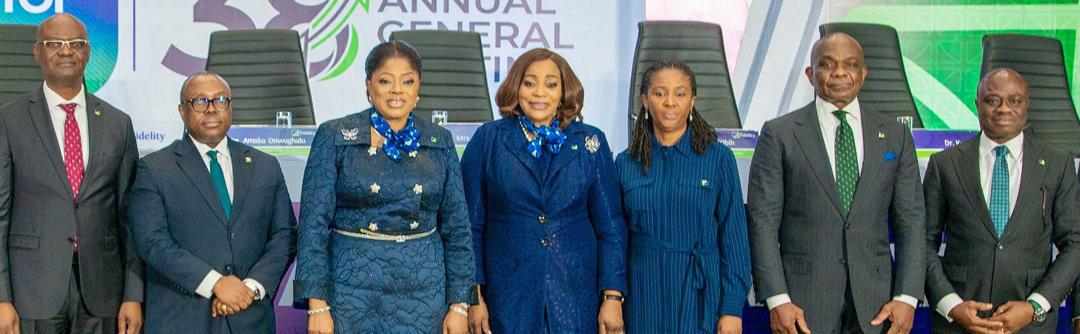
Shareholders of Fidelity Bank Plc have commended the bank’s Board and Management for strengthening its capital base, improving asset quality and sustaining earnings growth despite challenging operating conditions.
The commendation came during the bank’s 38th Annual General Meeting, held virtually on October 9, 2026, where shareholders reviewed its financial performance for the year ended December 31, 2025.
National Coordinator of the Pragmatic Shareholders Association of Nigeria, Bisi Bakare, highlighted the bank’s non-performing loan ratio of 2.4 per cent and capital adequacy ratio of approximately 16.1 per cent as indicators of its financial resilience.
Bakare also cited the bank’s customer base and financial indicators as reasons for shareholders to maintain confidence in its Board and Management.
Similarly, Chairman of the Progressive Shareholders Association, Boniface Okezie, commended the bank’s leadership for completing its capital-raising exercise and positioning the institution above the new regulatory minimum capital requirement.
Fidelity Bank completed a 227.05 billion naira private placement in December 2025, increasing its eligible capital from 305.5 billion naira to 532.6 billion naira, above the 500 billion naira minimum requirement for banks with international authorisation.
Presenting the bank’s performance, Board Chairman, Amaka Onwughalu, said the institution remained focused on building a stronger, more sustainable organisation capable of delivering long-term value through trust and innovation.
The bank’s 2025 financial statements showed that gross earnings rose by 45.6 per cent to 1.52 trillion naira, compared with 1.04 trillion naira in 2024. Profit before tax stood at 347.7 billion naira, while profit after tax reached 242.4 billion naira.
Its asset quality also improved, with the non-performing loan ratio declining from 3.1 per cent to 2.4 per cent, while the loan-loss coverage ratio increased from 138.4 per cent to 203.9 per cent.
Liquidity stood at 66.5 per cent, above the regulatory minimum of 30 per cent, while total equity increased to 1.09 trillion naira from 897.9 billion naira.
Managing Director and Chief Executive Officer, Nneka Onyeali-Ikpe, said the bank’s strategy remained focused on strengthening institutional resilience, deepening customer relationships and creating sustainable value for stakeholders.
External auditors, Deloitte & Touche, issued an unmodified opinion on the bank’s financial statements, confirming that they fairly presented its financial position, performance and cash flows in accordance with applicable reporting standards and Nigerian laws.
During the meeting, shareholders considered the bank’s audited financial statements and reports from the Directors, External Auditors, Statutory Audit Committee and Independent Board Appraisal Consultants.
They also considered the election of Jonathan Ososuakpor as a Non-Executive Director, the re-election of Amaka Onwughalu and the retirement by rotation of Nelson Nweke.
Other resolutions included authorising the Directors to determine the remuneration of the External Auditors for the 2026 financial year, disclosure of management remuneration and the election of members of the Statutory Audit Committee.
Shareholders urged the Board and Management to sustain the bank’s financial performance, strengthen its competitiveness and improve returns to investors.